Class of 1996
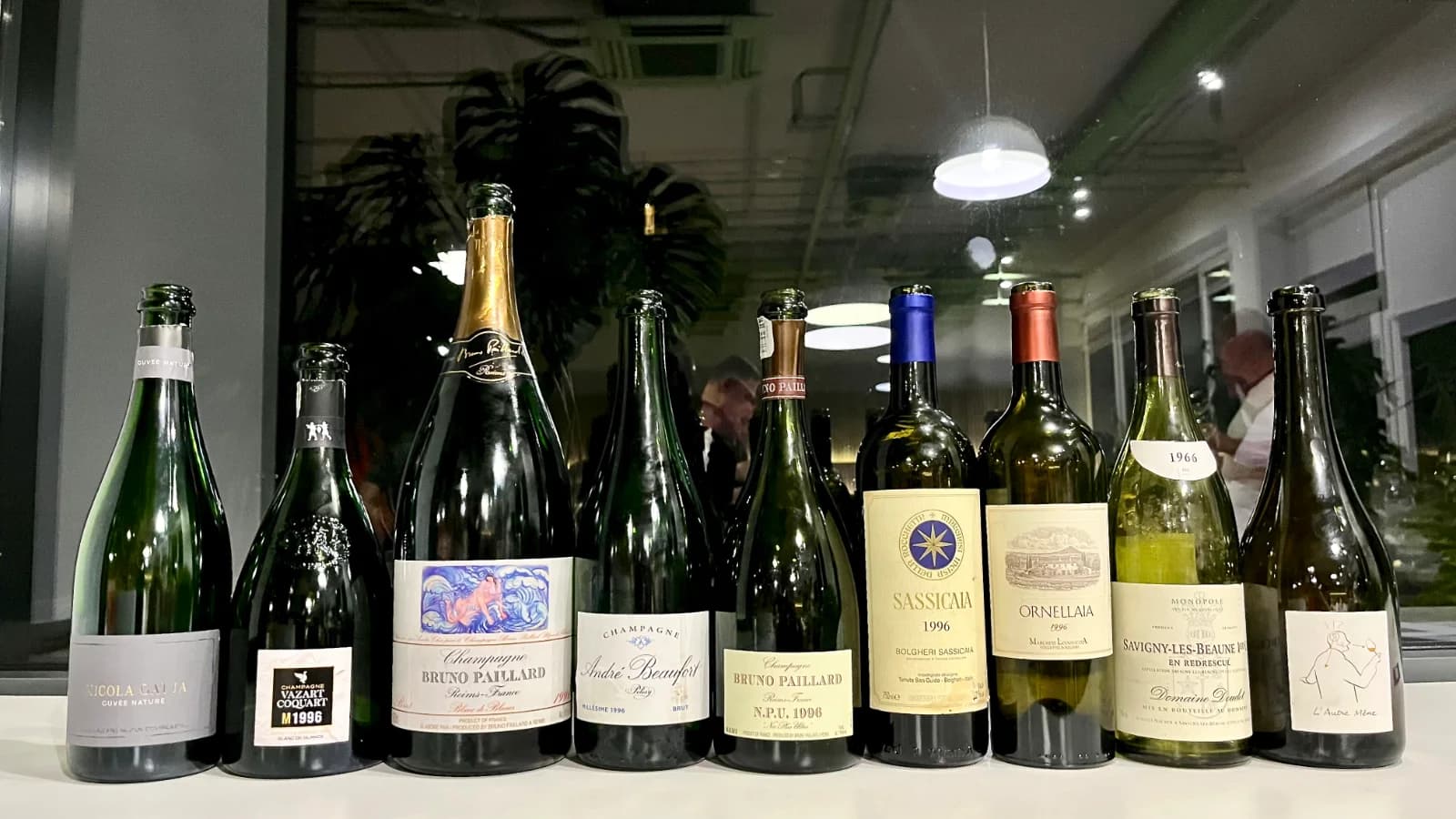
Six bottles from the 1996 harvest, three Champagnes and the two Bolgheri neighbours, plus a Gussago opener and a Selosse liqueur, poured for charity on their thirtieth birthday.
By Boris · Hosted by Boris Buliga
1996 was a good year to be born. Champagne picked a harvest it still measures others against, Bolgheri had just been handed an appellation of its own, and in Ukraine a new currency was coming off the presses. Thirty years later, six bottles from that harvest sat on one table: four Champagnes from three cellars that could hardly be more different from one another, one of them poured from a magnum, and the two Bolgheri neighbours that have been compared to each other for as long as either has existed.
Thirty years is a long time for a wine. Some of these were singing, some were whispering, and that was the point of opening them side by side rather than one at a time over another decade. Two guests from other years kept the class company: a Gussago sparkler from a man who refuses to call his wine Franciacorta opened the evening, and a Selosse liqueur of 2008 to 2010 musts, which is not allowed to call itself ratafia, closed it. Between the reds and the liqueur a secret bottle appeared, poured blind, older than anything else on the table and tasting younger than most of it. The night was a fundraiser, and every ticket went to the cause in full. The wines were why twelve people came.
How it went: the Beaufort and the Selosse were my wines of the night, the two Blanc de Blancs told the story of what a disgorgement date means, the Vazart was the one bottle a step past its peak, and the secret bottle, a 1966 white Savigny, walked away with the biggest surprise.
| Wine | WAVG | SD | ||
|---|---|---|---|---|
 Nicola Gatta | #9 | 4.03 | 0.12 | – |
 Vazart-Coquart & Fils | #8 | 4.15 | 0.08 | – |
 Bruno Paillard 1.5L · Magnum | #5 | 4.41 | 0.14 | 1 |
 Polisy Millésime1996 André Beaufort | #4 | 4.44 | 0.14 | 3 |
 N.P.U.1996 Bruno Paillard | #6 | 4.39 | 0.11 | – |
 Sassicaia1996 Tenuta San Guido | #7 | 4.26 | 0.15 | 1 |
 Ornellaia1996 Tenuta dell'Ornellaia | 🥈 | 4.46 | 0.12 | 2 |
 Domaine Doudet | 🥈 | 4.46 | 0.15 | 3 |
 Jacques Selosse 700 mL | 🥇 | 4.74 | 0.18 | 4 |
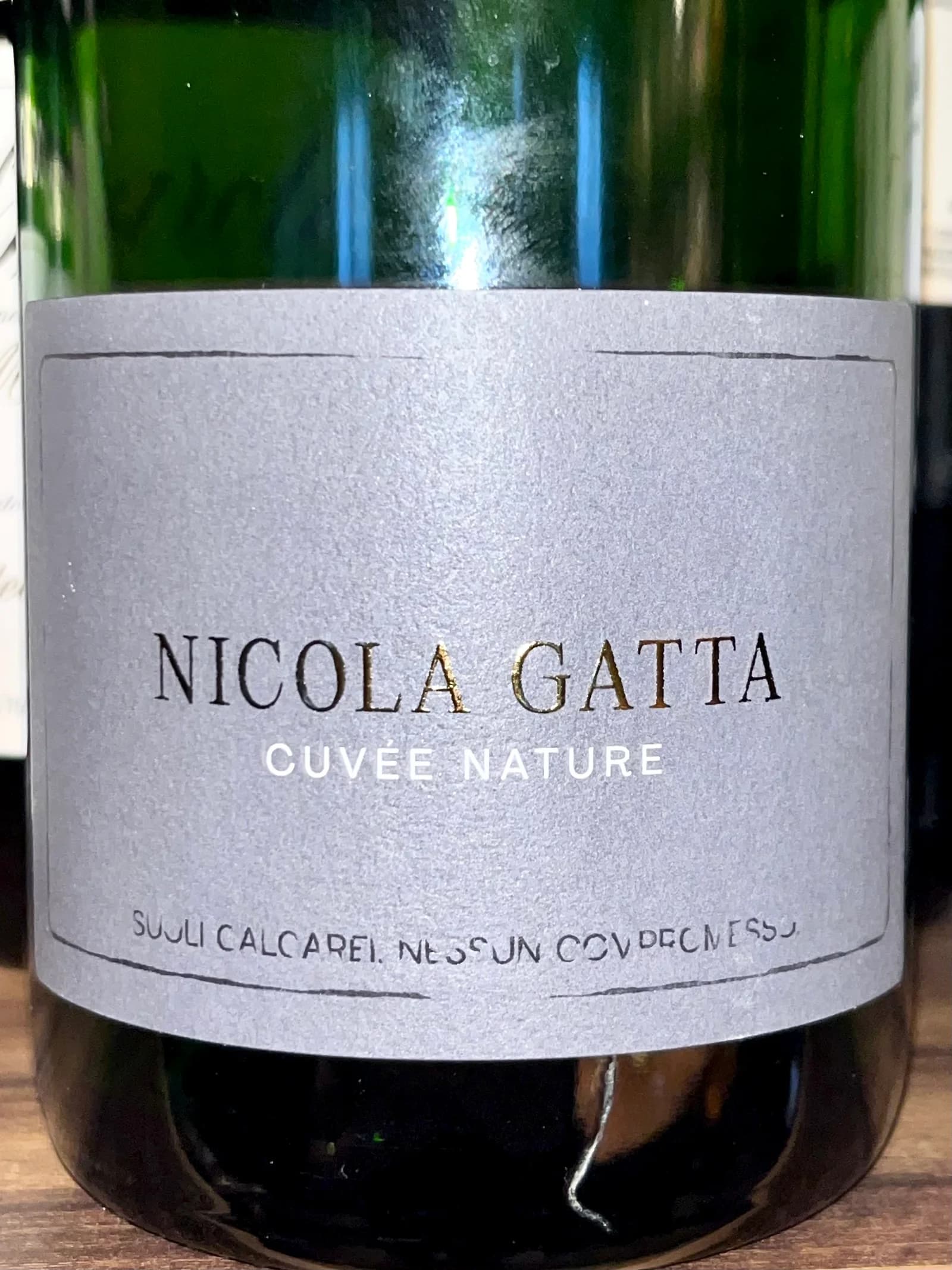
Nicola Gatta Cuvée Nature d2024-09 CN6
Nicola Gatta could make Franciacorta. His seven hectares in Gussago and Cellatica sit inside the zone, on the right limestone, planted to the right grapes. He went to Tuscany and Umbria as a young man to see how the serious wineries did it, came home knowing mostly what he did not want to do, and has been bottling Vino Spumante on his own terms ever since, through what he admits were ten or fifteen very hard years. Biodynamic vines, spontaneous fermentation, nothing fined, nothing filtered, no sulphur added at any point. He even keeps his own calendar: the wines are named for the moons they spend on the lees, not the months, so Cuvée Nature is thirty lune, about 80% Chardonnay and 20% Pinot Nero fermented in tonneaux and finished with zero dosage. This lot, CN6, was disgorged in September 2024. It is not a 1996. It is the doorman, and a good one.
The full note is for members.
Join to read it and the restVazart-Coquart & Fils Blanc de Blancs Millésime 1996
The Vazarts have been picking grapes in Chouilly, the northernmost Grand Cru of the Côte des Blancs, since 1785, and waited until 1950 to put their own name on a bottle. Jean-Pierre, the third generation, farms about 11 ha in 30 parcels, nearly all of it Chardonnay, and keeps his wines in steel because he would rather you tasted the village than the barrel. The house also does something most growers do not: it leaves old vintages asleep on their lees in its own cellar and disgorges them when someone asks. This one went into bottle in April 1997 and was woken in June 2025, 28 years later, with 2 g/l of sugar and not a gram more. It was a year built for that kind of sleep. The 1996 harvest gave Champagne grapes with sugar and acidity both far above normal, a pairing the region's records say had no equivalent since 1950, and it is that tension that lets a wine spend three decades on its yeast and come out the other side still awake.
The full note is for members.
Join to read it and the restBruno Paillard Blanc de Blancs Magnum 1996
In 1981 a broker's son of 27 sold his vintage Jaguar to buy his first barrels and founded the first new house Champagne had seen in nearly a century. The Paillards had brokered grapes in Bouzy and Verzenay since 1704; Bruno just wanted his own name on the label. Two years in, he started printing the disgorgement date on every bottle, the first house to do it, and the habit says everything about him: a Champagne should tell you when it was born and when it woke up. This one is Chardonnay from Le Mesnil-sur-Oger and Oger, first pressing only, 7,052 bottles and 2,984 magnums. Ours slept fifteen years on its lees and was disgorged in January 2012, one of at least two tranches. Every Paillard vintage gets a word from the house and a painting from an artist to match. For the 1996 the word was Profondeur, depth, and the painter was Sandro Chia, whose figure sinking through rolling waves is on the label, the first label he had ever painted for a winery outside Italy.
The full note is for members.
Join to read it and the restAndré Beaufort Polisy Millésime 1996
In 1969 Jacques Beaufort, a grower in Ambonnay, got sick from the chemicals he was spraying on his vines. By 1971 he had thrown them out, decades before anyone in Champagne thought that was a reasonable thing to do, and started treating the vineyard with essential oils, then homeopathy, weeding by hand and refusing for years to pay anyone for a certificate that said he was organic. The family later moved most of its vines to Polisy, in the Côte des Bar, and his sons Constant and Réol run the place now with the same stubbornness. Indigenous yeasts in cask or tank, malolactic whenever spring decides, bottles left on their lees until someone buys them, then disgorged by hand. The Polisy vintage is about 80% Pinot Noir and 20% Chardonnay. Our lot of the 1996 was disgorged in March 2023, more than 26 years after a harvest that began with minus 20 C in February and frost in May, and ended with the Côte des Bar counted among the best of the region.
The full note is for members.
Join to read it and the restBruno Paillard N.P.U. 1996
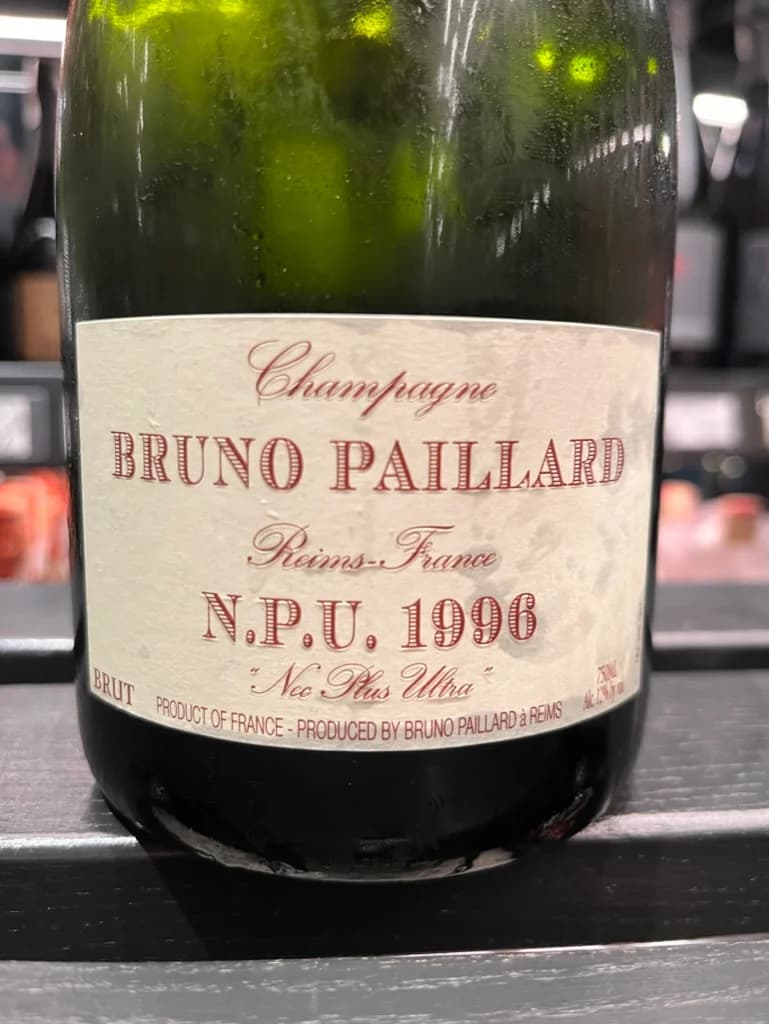
Nec Plus Ultra, nothing beyond. Bruno Paillard makes it only in the years he believes deserve it, and his daughter Alice, who runs the house now, is careful to say it is not meant to be the best wine but the one pushed furthest, where liveliness counts for more than richness. Half Pinot Noir, half Chardonnay, from seven Grands Crus: Oger, Le Mesnil-sur-Oger, Chouilly, Cramant, Verzenay, Mailly and Bouzy. Ten months in small old oak barrels, twelve years on the lees, then two more years of rest after disgorgement before anyone is allowed to buy it. The 1996 was disgorged in January 2009. By tonight it had spent thirteen years on its yeast and another seventeen in glass, which is a long way beyond for a wine that already calls itself nothing beyond.
The full note is for members.
Join to read it and the restTenuta San Guido Sassicaia 1996
Sassicaia started as one man's stubbornness. Mario Incisa della Rocchetta, a marchese who liked Bordeaux more than Chianti, planted Cabernet Sauvignon on the stony hill of Castiglioncello di Bolgheri in 1944 because the ground reminded him of Graves, and then drank the result at his own table for more than twenty years before letting anyone else buy it. The 1968 was the first commercial release, with Giacomo Tachis consulting, and it went on to invent a category. By 1996 the estate had the rarest prize in Italian wine, an appellation of its own: the Sassicaia sub-zone of Bolgheri DOC, created in 1994 for this one property, and the 1996 is among the first vintages to wear it. The estate remembers the year as a hard one for Italy from which the coast escaped, with a cold snap in late April that thinned the crop and a cool late summer that took its time; picking ran from 16 September to mid October. Cabernet Sauvignon with Cabernet Franc, 85/15 as always, steel fermentation with two weeks on the skins, then about 22 months in barriques, half new, bottled unfiltered, Tachis still watching over it. 12.5%.
The full note is for members.
Join to read it and the restTenuta dell'Ornellaia Ornellaia 1996
Ornellaia is the neighbour's reply. Lodovico Antinori founded it in 1981 on land next to his uncle Mario's Sassicaia, hired a young Hungarian called Tibor Gál to make the wine, brought in Michel Rolland to advise, and released his first vintage, the 1985, in 1988. Masseto, the Merlot from the clay hill, followed a year later. The 1996 belongs to the last stretch of the Antinori years: Robert Mondavi bought his first stake in 1999, Frescobaldi came in as partner, and since 2005 Frescobaldi has owned it outright. It is a Bolgheri Superiore of 75% Cabernet Sauvignon, 20% Merlot and 5% Cabernet Franc, picked between 8 September and 9 October after a cool spring, a wet August and a September that finally warmed up. Part of it fermented in wooden vats and part in steel, 25 to 32 days on the skins, then 18 months in barriques, 60% new, each parcel aged apart until the final blend. 13.5%. Two estates a few kilometres apart, two Cabernet blends, one leaner and one fuller in every sense, finally at the same table on the same night.
The full note is for members.
Join to read it and the restDomaine Doudet Savigny-lès-Beaune 1er Cru En Redrescul Monopole 1966
The secret bottle. En Redrescul is the steepest vineyard in Savigny-lès-Beaune, a Premier Cru of about 65 ares that the Doudet family owns outright and the only Premier Cru of the appellation made entirely in white, Chardonnay on a slope so severe that everything is done by hand and by horse. The family has farmed in Savigny since the 1930s, behind the négociant house of Doudet-Naudin that dates from 1849, and under the house at 3 rue Henri Cyrot the cellars, whose oldest part goes back to 1820, hold old vintages that the house lets sleep for decades. This one was bottled on 24 January 1968, unfiltered and never chilled, from a year with a gloomy summer that a fine September rescued. It went on the table blind, between the Bolgheri reds and the liqueur, and the guesses ran from the fifties on, because nobody believed a Savigny blanc could do this at sixty.
The full note is for members.
Join to read it and the restJacques Selosse L'Autre Même Liqueur
Anselme Selosse came home to Avize from his studies in Burgundy in 1974 with a heresy: that a Champagne grower should think about terroir, ripeness and oak the way a Burgundian does, and that quantity was never the point. Fifty years on, half the region's growers owe him something. Alongside the Champagnes he keeps a quieter hobby. Ratafia is Champagne's old kitchen liqueur, fresh grape must stopped with spirit at harvest, and Selosse started making his own in 1997 under the name Il était une fois, leaving the casks outside the winery in all weather and never topping them up as they evaporated. L'Autre Même, the other same, is the second attempt: Chardonnay must from the 2008, 2009 and 2010 harvests, fortified and left in cask for at least twelve years, bottled in 2022 by Anselme and his son Guillaume, 3,000 bottles, on sale since 2024. So why does the label say Liqueur, grape must and alcohol, and not Ratafia? Because in 2015 Ratafia champenois became a protected name with a rulebook attached, and the rulebook wants between 16% and 22% alcohol. Selosse bottled his at 15%. One degree short, and the old family word is off limits, which is a very Selosse way to end up with a ratafia in every sense except the legal one.
Wow. This is unbelievably delicious. Pine cone jam, white cherry, milk chocolate, grated white plum, dates and rosehip tea, then honey, caramel, tangerine peel and toasted nuts, with dried flowers, lavender and chamomile somewhere behind. It is very sweet and it does not matter, because the acidity is superb and the whole thing sits in balance, soft in outline and vibrant inside. So many faces, and it keeps changing in the glass for as long as you leave it. Not a ratafia, says the label. Whatever it is, I want more.