Region
France › Burgundy › Côte d'Or › Côte de Beaune › Volnay › Volnay AOC
Type
red · still
Grapes
Pinot Noir
Alcohol
13%
Volume
750 mL
Bottled
2020-03-01
Tasting Notes(1)
4.1
The full note is for members.
Join to read it and the restAbout
Nicolas Rossignol is a fifth-generation Volnay grower, born in 1974, who started vinifying in 1994 at the family estate Rossignol-Jeanniard and set up on his own in 1997 with three hectares. The two labels merged under his name in 2011, and the domaine now works about twenty hectares across roughly thirty appellations, with the premier cru sites bottled under their own names. The winemaking sits in Beaune, in a 1,600 square metre bioclimatic cuverie finished in 2016, where the whole harvest is now vinified.
Rossignol describes his own farming as reasoned viticulture worked to the lunar calendar, with no chemical herbicides and light ploughing to keep the soils open. Merchants tend to render that as biodynamic principles, which reaches further than his own wording goes; the domaine is not certified organic or biodynamic. Fruit arrives by hand in eight-kilo boxes, crosses a vibrating table, then goes to six people sorting whole bunches, and reaches the vat by conveyor so the berries stay intact. Whole clusters are a judgement call rather than a fixed percentage: bunches either go to a destemmer that frees the berries without bursting the skins, or straight into the vat unhandled. He has said in interview that he moves between the two by year, because stems that are not ripe enough leave a green flavour that stays in the wine for good. Fermentation runs on indigenous yeasts for six to eight days. Malolactic is deliberately held back to the following spring. Ageing lasts ten to twenty months on fine lees with no racking, new oak set anywhere from zero to fifty percent by vintage and site, and the wine goes into bottle unfined and unfiltered.
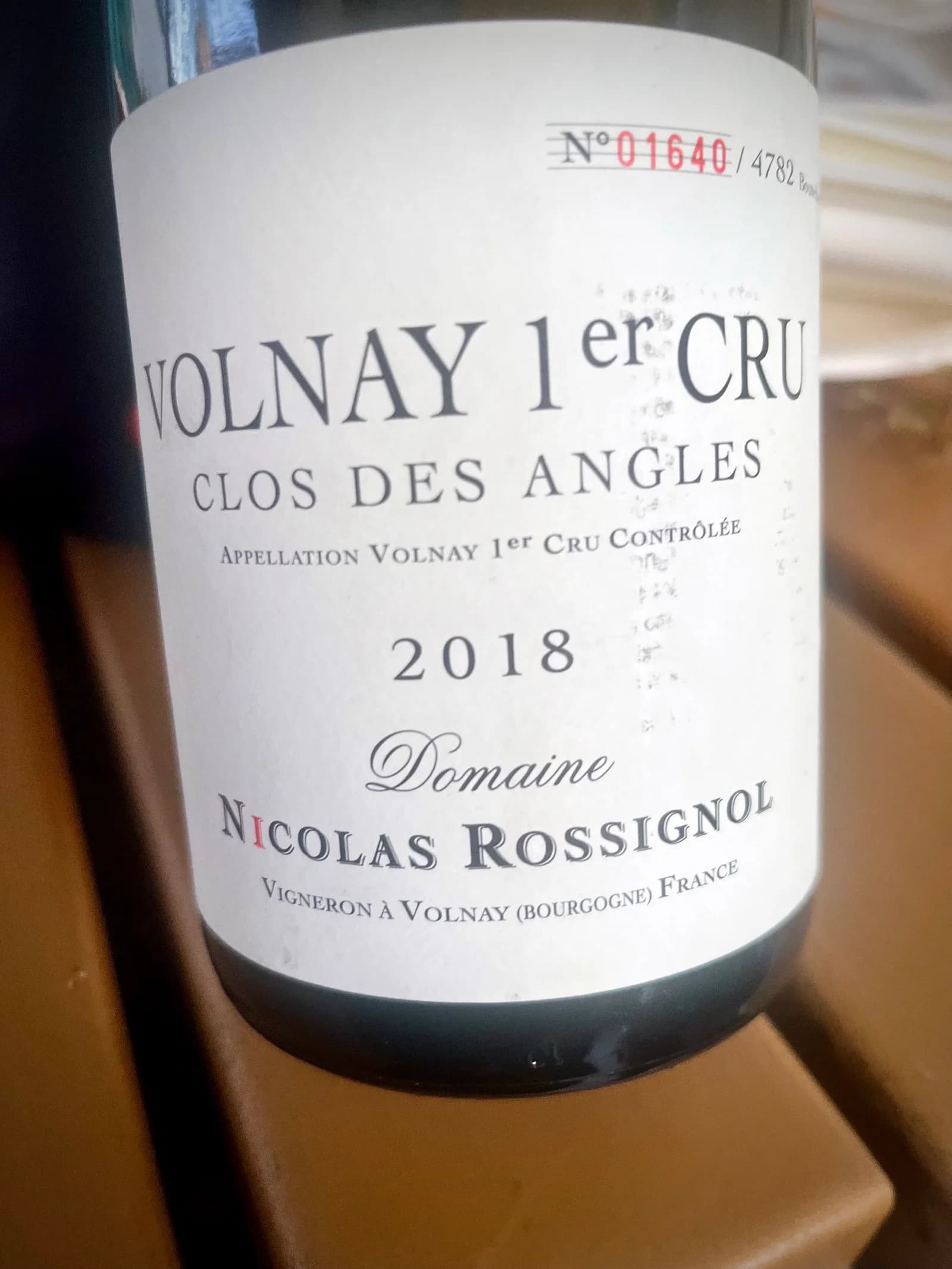
The village Volnay comes off the bottom of the slope, below the premiers crus Clos des Angles and Chevret, on deep limestone and clay with very few stones in it. The domaine blends four lieux-dits here, Les Buttes, Les Grands Champs, Les Famines and Les Lurets, from vines of ten to sixty years, and frames this as the bottling to drink rather than cellar. One merchant's note on the 2017 describes a wider spread: vines of fifteen to seventy-five years, a fifth lieu-dit in La Gigotte, and a stony limestone section sitting above the premiers crus instead of below them. The domaine's own text mentions no upslope fruit. This bottle is numbered 05865 of 10,379.
2017 followed the frost-hit 2016, and Jasper Morris records a much more abundant Pinot flowering and a return to normal, even quite generous volumes. The spring is disputed: Berry Bros reports a severe frost threat around 27 April, averted by burning straw bales, with a little damage to low-lying vineyards on the wrong side of the road, while Goedhuis holds that the Côte d'Or saw no spring frost at all that year outside Chablis. The July storms that hit Morey-St-Denis and Beaujolais left the Beaune side alone. July and August were warm and sunny, and rain came at the end of August. The two houses part again on September: Morris has the first half cooler and showery, Goedhuis an early harvest in ideal conditions. On Morris's account the first Côte de Beaune reds came in on 4 September. Volnay AOC, 13%.