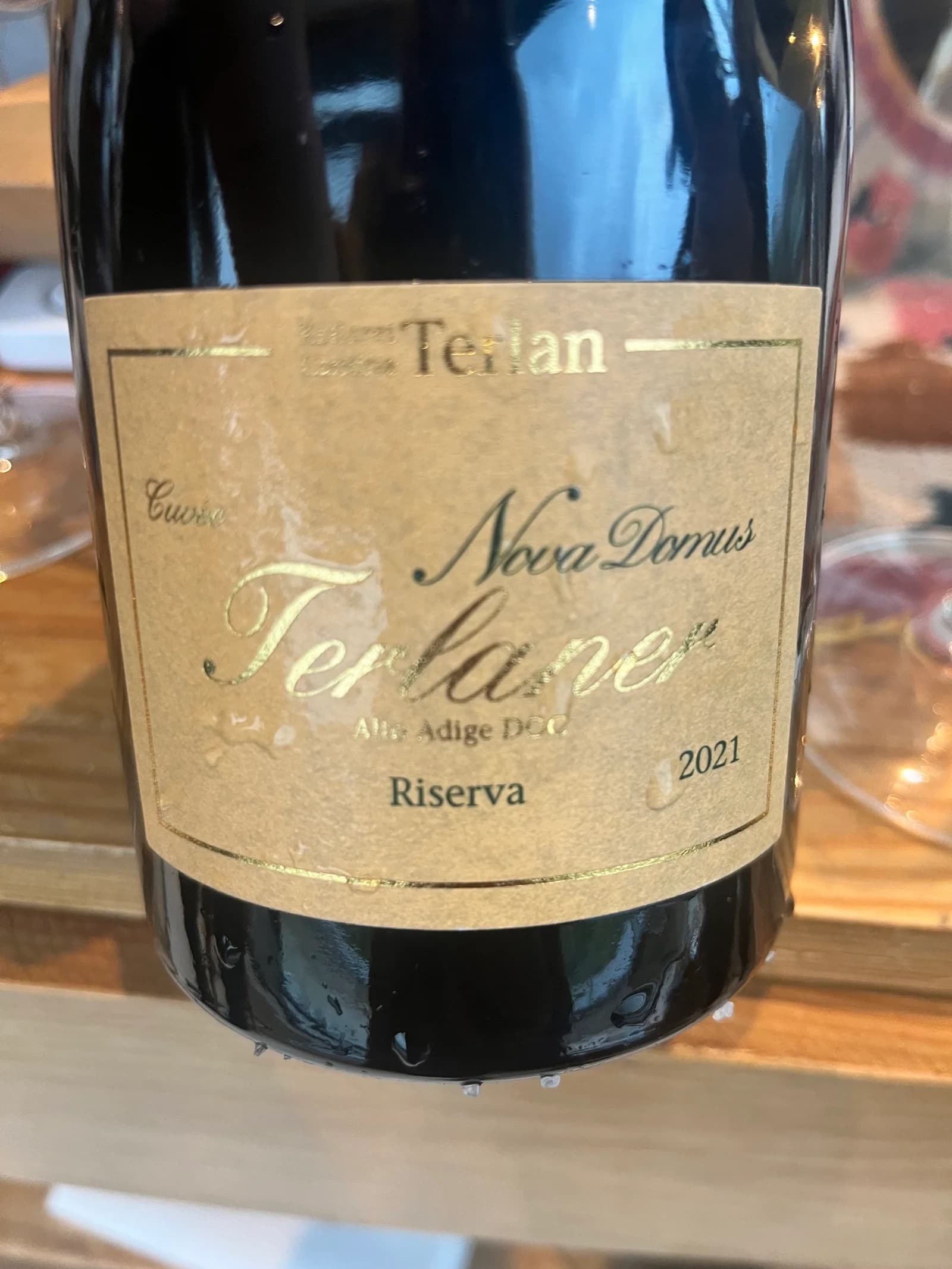
Region
Italy › Trentino-Alto Adige › Alto Adige › Alto Adige DOC
Type
red · still
Grapes
Pinot Noir
Alcohol
14%
Volume
750 mL
Sugar
0.3 g/L
Bottled
2020-06-12
Tasting Notes(1)
3.8
The full note is for members.
Join to read it and the restAbout
Cantina Terlano is a growers' cooperative founded in 1893 in Terlano, about ten kilometres north-west of Bolzano, with 143 member growers and a cellar that turns out roughly 70 percent white and 30 percent red, all of it at DOC level. Monticol is the cooperative's Pinot Noir from its Selections line, which sits above the Tradition varietal wines, and it is released as a Riserva. The quote on the producer's page from Rudi Kofler, the cellar master, places the variety at medium to high altitude, 450 to 600 m, where downslope winds cool the vineyards even in midsummer, and notes that Pinot Noir has been grown in the cooperative's vineyards since the middle of the nineteenth century, with the older vines giving the most structured and elegant wine.
The vineyards sit on the red porphyry that defines Terlano: a siliceous volcanic rock that weathers into deep, skeletal, sandy to sandy-loam soils with a very high stone fraction and low to moderate carbonate content, free-draining and nutrient-poor, which the cooperative credits for naturally limited yields. For the 2018 Monticol the producer's tech sheet gives 100 percent Pinot Noir from south-west and east facing sites at 450 to 600 m, on slopes of 5 to 70 percent, at a yield of 40 hl/ha. The grapes are hand-harvested and sorted, destemmed, and fermented slowly at a controlled temperature in stainless steel with gentle agitation of the must; after malolactic fermentation the wine ages for twelve months, 30 percent in large wooden barrels and 70 percent in barriques of which a third are new, and the lots are blended three months before bottling. The finished wine is 14 percent alcohol with 0.3 g/l residual sugar and 5.7 g/l total acidity. The lot on the back label, L20164, reads as day 164 of 2020, that is 12 June; the importer's sticker prints 8 June 2020 as the date of manufacture, a few days earlier.
The producer's own report calls 2018 an extreme year in weather terms. A snowy winter and a rainy March left the vines with excellent water reserves; cool early-spring temperatures held budburst back to mid-April, later than in 2017, but the season then turned almost summery, alternating with heavy rain, and the first flowers opened at the end of May. A hot June ended in a strong hailstorm that damaged some of the cooperative's vineyards; July and August were a long heatwave without rain, broken by heavy rain in early September. As in 2017, picking began on 22 August. The cooperative's verdict is that the vintage was satisfactory in both quantity and quality.