All producers
Cantina Produttori Nebbiolo di Carema
Alto Piemonte, Italy8 wines4.0 avg
62
On 25 November 1960, ten growers who lived in Carema signed the founding act of the Cantina dei Produttori Nebbiolo di Carema. Their first president was Arturo Perono, and in more than sixty years there have been only four. Matteo Bosonetto has led the cooperative since 2022. By 2015 it had 101 members, 71 of them delivering grapes, all part-time growers with an average age of about 55.
Carema is the last village in Piedmont before the Aosta Valley, on the left bank of the Dora Baltea. Its vineyards climb the mountain on terraces: dry-stone walls holding moraine soil carried up from the valley floor. The vines grow on pergolas, called topia in the local dialect, resting on tapered columns of stone and lime known as pilun. The columns soak up the day's sun and give the heat back at night, softening the swing between day and night.
The cooperative and its growers farm about fifteen hectares on steep, rocky slopes in the bowl around the village. Harvest starts in mid-October, by hand, into wicker baskets or small crates, and the bunches are sorted before they reach the cellar.
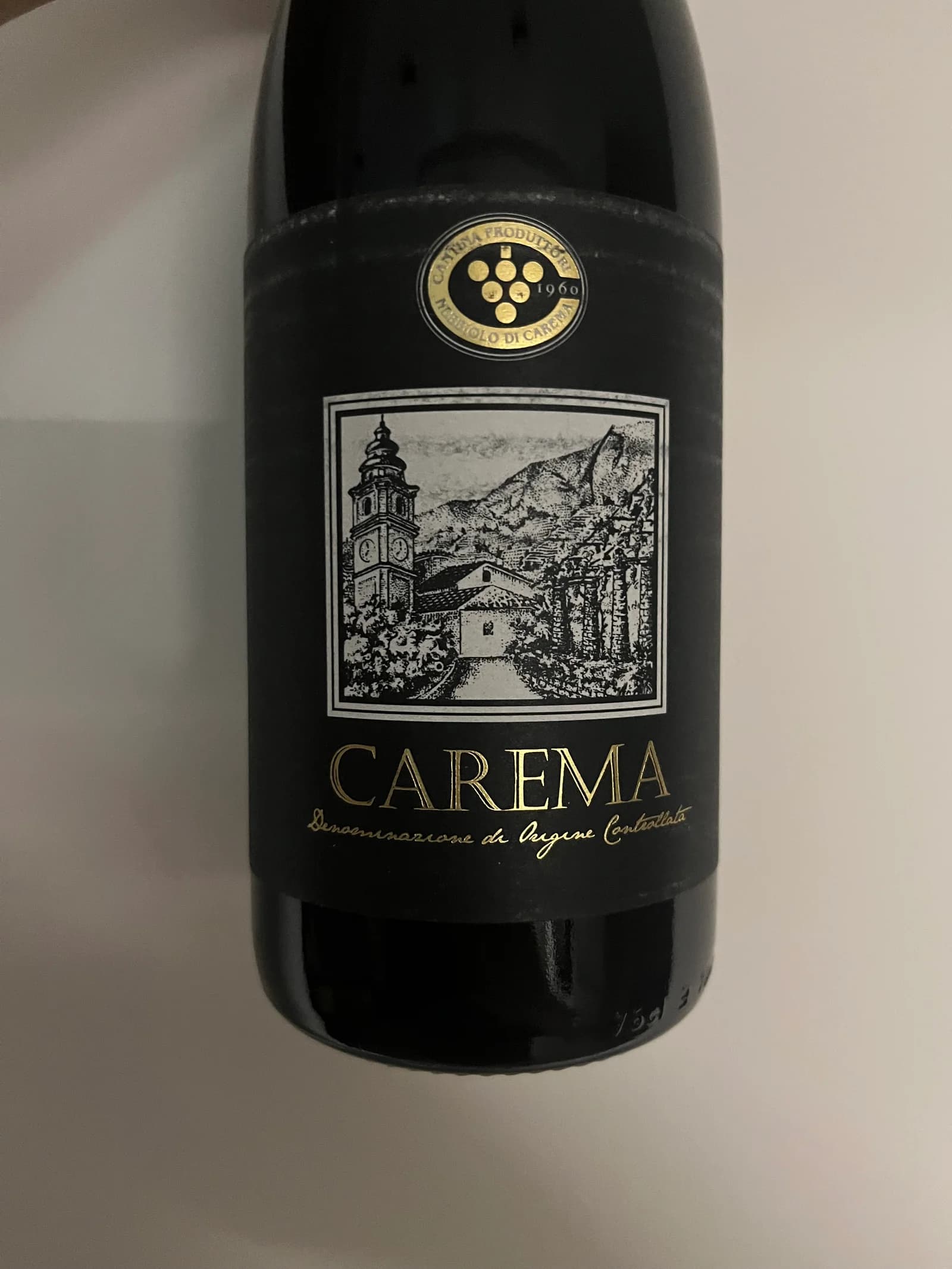
Carema comes in two versions. The black label spends at least two years ageing, twelve months of it in large oak or chestnut casks. The white-label Riserva needs three years, eighteen months in cask, and was first made in 1979 from the 1974 vintage.
In 2013 the ageing cellar was renovated and many old casks were replaced with new Slavonian oak. Cellarman Manlio Muggianu, there for more than thirty years, makes the wines with oenologist Maurizio Forgia. Among the other wines are a younger Canavese Nebbiolo, Paré, and Lunaneuva, a traditional-method rosé from Nebbiolo.
Since 2014 Carema has been a Slow Food presidium, set up to protect the terraces and the way of farming them. In 2023 the cooperative began working with the Merum Club, a circle of patrons around the German publisher Merumpress, which paid to buy and restore an abandoned plot of about 600 square metres. The scrub was cleared, the walls rebuilt, the chestnut pergolas put back and the vines replanted. The vineyard was inaugurated in August 2026, and its first harvest is expected in 2028.
For a cooperative that has spent sixty years keeping these terraces in use, it is a small plot with a clear message: a terrace lost to scrub can still be won back.