All producers
Forjas del Salnés
Galicia, Spain1 wine4.4 avg
Rodrigo Méndez's project in Meaño, Val do Salnés - old-vine Albariño and Atlantic reds grown on granite close to the sea.
Forjas del Salnés began in a garage in Meaño, Val do Salnés, in 2005. The name means "the forges of Salnés" and points at Francisco Méndez, grandfather of founder Rodrigo "Rodri" Méndez - a blacksmith and vigneron who ran an ironworks, was one of the founding figures behind the Rías Baixas DO in 1988, and, against the tide of the Albariño boom, kept planting and preserving the red grapes his neighbours were ripping out - Caíño Tinto, Espadeiro, Loureiro Tinto. When Francisco died in 2001, Rodri inherited a collection of old parcels and an unfinished idea: serious red wine from the coldest, wettest corner of Rías Baixas. He launched the project together with Raúl Pérez of Bierzo, who pushed him not to abandon the old-vine Albariños either; Pérez still makes his Sketch Albariño in the Forjas cellar - its famous under-the-sea ageing was an experiment that never reached the market.
The vineyards - reportedly some 10-12 hectares across many small parcels - sit in Val do Salnés, the coolest and wettest subzone of Rías Baixas, on decomposed granite (locally sabrego) and sand, a stone's throw from the Atlantic; the red parcels behind Bastión de la Luna lie at roughly 5 meters above sea level, planted from 1963. At the far end of the age scale is the extraordinary Finca Genoveva, a parcel belonging to Doña Lola that Rodri rescued, its ungrafted Caíño and Albariño commonly cited at 150-200 years old - the old farm building still holds chestnut vats said to have been built by Lola's parents.
The cellar work is old-school Galician: indigenous yeasts, rarely any temperature control, whites without malolactic, long lees ageing with no batonnage, and large old wood - foudres and oval casks of roughly 2,000-5,000 liters. Reds ferment largely whole-cluster in open vats, some foot-trodden, and age in used French oak; sulphur is minimal, added at bottling.
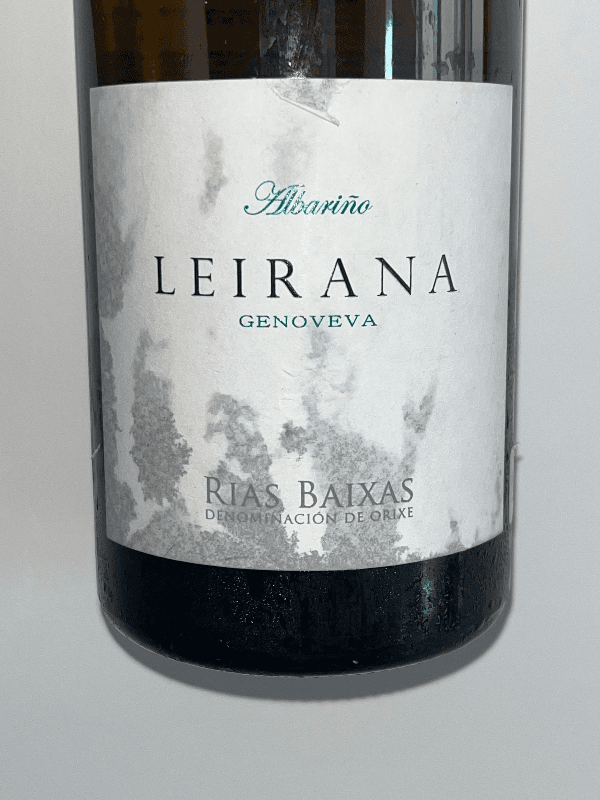
The range splits in two. The Leirana whites: the flagship Leirana Albariño, the old-vine Leirana Finca Genoveva (fermented and raised on its lees in a large seasoned oak foudre), and Cos Pés - Galician for "with the feet" - an Albariño foot-trodden and fermented on its skins for around two months, roughly 1,200 bottles. The Goliardo reds - named for the wine-loving goliard scholars of the Middle Ages - are varietal bottlings of Caíño, Espadeiro and Loureiro Tinto, alongside Bastión de la Luna, a rough-thirds blend of the three, and a separate Finca Genoveva tinto, 100% Caíño from the ancient parcel, aged around 24 months in old foudres. These salty, peppery, 11.5-12.5% Atlantic reds did more than any other wines to revive red winemaking in Rías Baixas - and the old-parcel whites made the same argument for Albariño as a serious, age-worthy grape.